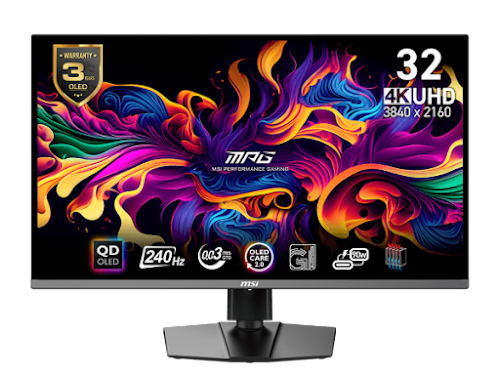
Tired of lag ruining your gaming experience? MSI's MPG 321URX is here to save the day with its 4K resolution, 240Hz refresh rate, and QD-OLED magic. Get ready for smoother gameplay, stunning visuals, and a competitive edge like never before! TL;DR: "MSI's MPG 321URX monitor is a game-changer, boasting 4K resolution, 240Hz refresh rate, and QD-OLED technology for buttery-smooth gameplay and jaw-dropping visuals. Say goodbye to lag and hello to gaming greatness!" What Makes the MSI MPG 321URX Special? Speed Freaks, Rejoice! Forget about choppy gameplay and frame drops. The MSI MPG 321URX boasts a blistering 240Hz refresh rate, meaning it can display a whopping 240 frames per second. This translates to butter-smooth visuals, allowing you to react instantaneously in even the most intense firefights. Feast Your Eyes: But speed isn't everything. The MSI MPG 321URX takes visuals to the next level thanks to its revolutionary QD-OLED panel. This innovative t…

For decades, the skies have been a canvas for the human imagination, dotted with tales of unidentified flying objects (UFOs) and whispers of extraterrestrial life. The modern fascination with these celestial mysteries took flight in the 1940s, post-World War II, when a surge of sightings captivated the public and gave birth to a new era of UFO lore. As the years progressed, the U.S. Air Force launched Project Blue Book in the 1960s, an ambitious attempt to catalog and investigate the myriad of UFO reports. Despite their efforts, they concluded that there was no evidence of visitors from other worlds. The intrigue only deepened in the 1990s when the infamous “Roswell Incident” was officially attributed to a military surveillance balloon, not a spacecraft from another galaxy. Fast forward to the present, and the Pentagon has once again made headlines with its declaration that there is no evidence of alien technology in its possession. This announcement might seem like a definitive end to …

In a bold and unprecedented move, a Google Cloud engineer took a stand against the potential misuse of technology during a keynote speech at the "Mind the Tech" conference in New York. The engineer's public refusal to participate in building technology that could be used for what they described as "genocide, apartheid, or surveillance," specifically in relation to Google's Project Nimbus—a contract to provide cloud services to the Israeli military and government—sent shockwaves through the tech community. However, this act of conscience came at a cost—the engineer was promptly dismissed from Google. This incident has ignited a fervent debate surrounding the ethical responsibilities of tech companies and their employees, especially concerning military contracts and the broader societal implications of technology. It lays bare the fundamental tension between innovation and ethics, forcing us to confront difficult questions about the moral compass guiding techn…

In the ever-evolving world of global tech, a fascinating narrative is unfolding—a narrative of ambition, strategy, and sovereignty. At the heart of this story is China’s “strategic decoupling” from Western technology, a move that could redefine the future of international tech dynamics. Why the Split? China’s decision to untangle its tech sector from Western influence is driven by a mix of vulnerability, ambition, and national security. The country’s reliance on foreign tech, especially in critical areas like semiconductors, has been a double-edged sword—spurring growth but also exposing it to geopolitical risks. With tensions rising, China is determined not to have its fate tied to external powers. But there’s more to the story than just self-preservation. China envisions itself as a tech superpower, leading the charge in innovation and setting global standards. Initiatives like “Made in China 2025” are testament to this vision, as China aims to dominate the tech scene with its own rule…


